La Boca: Caminito
Boys and Girls fifth year of school spent an afternoon Walsh Rodolfo in La Boca. They walked, looked, talked with locals ... The notes that follow share some of their impressions.
Wednesday, January 31, 2007
Under Arm Temperature Of 101
other looks possible, a play
A little history
The neighborhood of La Boca is a lowland area and floods easily, is not recommended as a site more habitable. However, even with this knowledge, it was not long before the bank met its banks an increasing number of shipyards, naval stores, wool and salting tanks, attracted by the possibility of working immigrants came from Greek, Turkish and Italian , among others. These immigrants from
poor began to lift boxes humble
zinc and wood known by the name of "tenement" who gave the mouth a peculiar physiognomy and colorful. Most were the Genoese, seafarers who settled there and painted their houses bright colors. A boat hanging on the door warning of the continuing threat posed by flooding.
Over time the population of the marine district was expanded, the Italians were more than the native Genoese dialect predominated over the Castilian, making it very difficult for teachers to impart their lessons. La Boca has become a noisy and exuberant people. Immigrants preserved intact the customs of his land but established a fraternal society with the first European institutions in Buenos Aires. Opened bars, a few still in use today, where you could taste the traditional dishes to the rhythm of a gay tarantella or a nostalgic canzonetta. They also learned to edit newspapers and magazines, founding clubs and theaters. The district produced poets, musicians and artists, even sent to Parliament the first socialist member of America (Alfredo Palacios).
And now ... what happens?
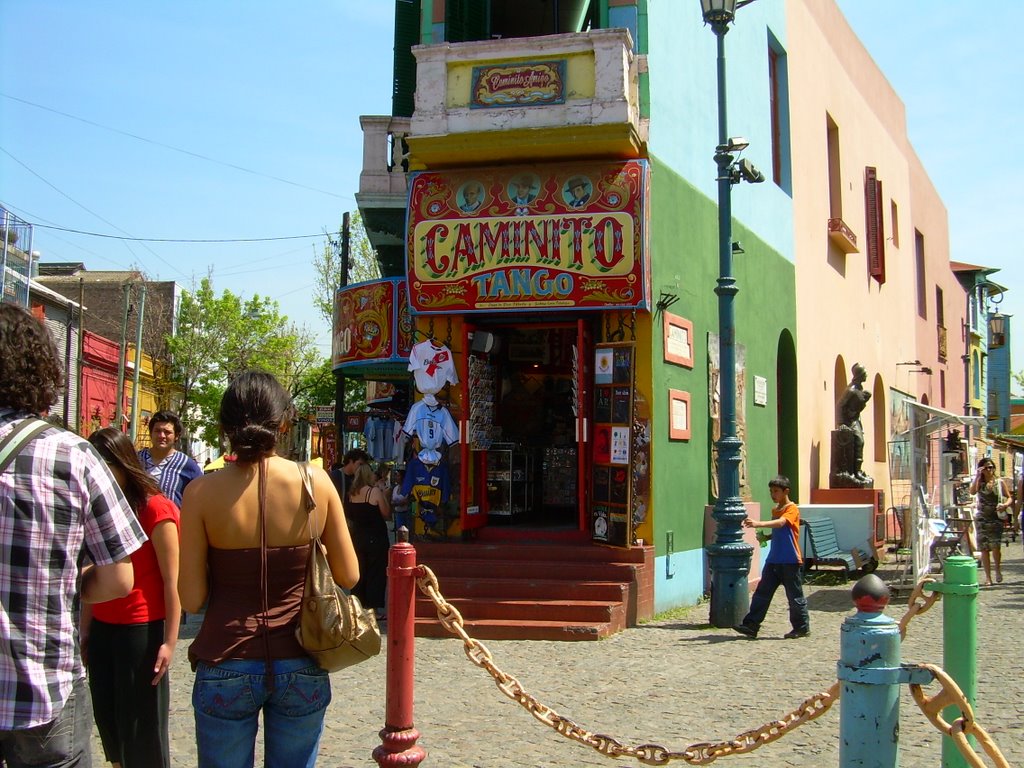
currently in La Boca, the area known as "Caminito" is the ultimate tourist destination and has become a "window" for walking and shopping for many foreign visitors who take advantage of your stay by taking photos, learning about the history of the place, watch couples dancing the tango, lunch or dinner in typical places and appreciating the craft and street performers, among other things. However, not everything seems so harmonious in the neighborhood: "This is used by many local owners of certain Caminito to 'hide' the real deal flows at night. (...). Here is full of foreigners, but not all employees as people think. Most are owners and take a lot of money in this neighborhood, because it has two entries of money. One is the place that used to sell domestic goods for example, or the odd little bar could tango, but where else are they silver is in the business that is at night when all the tourists go and close it. Here there are no kiosks kiosks, bars are not bars ... "(Roberto Diaz - Caminito dealer).
What is the business? "Prostitution?," The drug trade? The dealer was not very comfortable when you tell us the details, but so far we have reached, foreigners were very much involved in illegality. Is that what comes out negative? Obviously, there are a stark contrast in the neighborhood. The dealer we interviewed management poses a great enough money from foreigners, but a couple of blocks from Caminito could say that the neighborhood of La Boca is inhabited mostly by people with few resources and in many cases of foreign nationality as Bolivians, Paraguayans, Peruvians, who live in the tenements, in precarious conditions. Precisely in the area of \u200b\u200bCaminito is where many of these foreigners get their work in bars, stalls and other shops. This brings with it conflicts with Argentines living in the area, they complain that the few jobs that exist are occupied by them. "It makes me very angry, my family tried to avoid Caminito as a place to walk, many of my relatives are not laburo and these foreigners come here to take our jobs, do business with our neighborhood ... "- Stephanie Ojeda told us, an employee of one of the premises. This shows us that from the business "occupied" foreigners settled in the neighborhood kind of xenophobia that causes constant clashes between the owners of the premises. Clearly, then, that the neighborhood of La Boca has become a cool, fully profitable. "I do not like the tango, here I have to listen all day and I'm tired. I like rock and country disgusts me having to listen to tango all day wave local ... "We had an employee who wore a shirt of The Ramones."
This suggests that a kind of stage set up where everything seems perfect, but on the contrary, is a series of elements linked by a commercial interest: Caminito is a place that appears to be quite Buenos Aires and sentimental but it is actually play any profit, in which his players show what they have to show to receive the money when it ends.
Tango ... In the blood or in your pockets?
Caminito Street is the most precious of La Boca. Only 100 meters long, with cobblestone streets, murals, ceramics and other ornaments, is a pedestrian mall that recreates the old tenement houses painted in bright colors and the clothes hanging in their windows. It seems, by the attitude of those working in it, the color tango place and runs through the blood of all. But on the contrary there are those who hate it and only show a taste for this style of music to work. Romina is the case of Fernandez, who works at a local Caminito attracting tourists with the story he tells the tango, but wearing a shirt from "The Ramones". "... I live here 6 or 7 years ago. Since moving I have to listen to tango everywhere and I hate [...] but I have to put up with me because I'm laburo. Me I like rock & roll and every day I hope it ends the day to get home and listen to my music. "" ... It is the first job I have here. Recently a local laburo is a block and before that in another one in the corner - he said pointing to a place that sells leather-and all you hear nothing but tango [...] because they want tourists coming see this nationalist attitude like ... "
Tango street clothes but only a few hours, because if the premises are closed and tourists will all change and the climate is different. "All the locals go tango, but when they start closing mixed with cumbia able to run or some rock. Until closing all local and not heard a single song of tango ... "- told us laughing Luis Viale, a local worker Caminito .-" ... anyone realizes he does not like anyone here, put new issues which are as remixes. The singers old and barely listen ... "
Although they prefer another style of music, when a tourist approaches each takes tango fanaticism for infection, and thus attract the local course where you work. This action funny but sad at the same time makes us think about the essence of Caminito. Does
street tango? Buenos Aires Street "? ... Or which knew how to use a passion to make money?
A little history
The neighborhood of La Boca is a lowland area and floods easily, is not recommended as a site more habitable. However, even with this knowledge, it was not long before the bank met its banks an increasing number of shipyards, naval stores, wool and salting tanks, attracted by the possibility of working immigrants came from Greek, Turkish and Italian , among others. These immigrants from
poor began to lift boxes humble
zinc and wood known by the name of "tenement" who gave the mouth a peculiar physiognomy and colorful. Most were the Genoese, seafarers who settled there and painted their houses bright colors. A boat hanging on the door warning of the continuing threat posed by flooding. Over time the population of the marine district was expanded, the Italians were more than the native Genoese dialect predominated over the Castilian, making it very difficult for teachers to impart their lessons. La Boca has become a noisy and exuberant people. Immigrants preserved intact the customs of his land but established a fraternal society with the first European institutions in Buenos Aires. Opened bars, a few still in use today, where you could taste the traditional dishes to the rhythm of a gay tarantella or a nostalgic canzonetta. They also learned to edit newspapers and magazines, founding clubs and theaters. The district produced poets, musicians and artists, even sent to Parliament the first socialist member of America (Alfredo Palacios).
And now ... what happens?
currently in La Boca, the area known as "Caminito" is the ultimate tourist destination and has become a "window" for walking and shopping for many foreign visitors who take advantage of your stay by taking photos, learning about the history of the place, watch couples dancing the tango, lunch or dinner in typical places and appreciating the craft and street performers, among other things. However, not everything seems so harmonious in the neighborhood: "This is used by many local owners of certain Caminito to 'hide' the real deal flows at night. (...). Here is full of foreigners, but not all employees as people think. Most are owners and take a lot of money in this neighborhood, because it has two entries of money. One is the place that used to sell domestic goods for example, or the odd little bar could tango, but where else are they silver is in the business that is at night when all the tourists go and close it. Here there are no kiosks kiosks, bars are not bars ... "(Roberto Diaz - Caminito dealer).
What is the business? "Prostitution?," The drug trade? The dealer was not very comfortable when you tell us the details, but so far we have reached, foreigners were very much involved in illegality. Is that what comes out negative? Obviously, there are a stark contrast in the neighborhood. The dealer we interviewed management poses a great enough money from foreigners, but a couple of blocks from Caminito could say that the neighborhood of La Boca is inhabited mostly by people with few resources and in many cases of foreign nationality as Bolivians, Paraguayans, Peruvians, who live in the tenements, in precarious conditions. Precisely in the area of \u200b\u200bCaminito is where many of these foreigners get their work in bars, stalls and other shops. This brings with it conflicts with Argentines living in the area, they complain that the few jobs that exist are occupied by them. "It makes me very angry, my family tried to avoid Caminito as a place to walk, many of my relatives are not laburo and these foreigners come here to take our jobs, do business with our neighborhood ... "- Stephanie Ojeda told us, an employee of one of the premises. This shows us that from the business "occupied" foreigners settled in the neighborhood kind of xenophobia that causes constant clashes between the owners of the premises. Clearly, then, that the neighborhood of La Boca has become a cool, fully profitable. "I do not like the tango, here I have to listen all day and I'm tired. I like rock and country disgusts me having to listen to tango all day wave local ... "We had an employee who wore a shirt of The Ramones."
This suggests that a kind of stage set up where everything seems perfect, but on the contrary, is a series of elements linked by a commercial interest: Caminito is a place that appears to be quite Buenos Aires and sentimental but it is actually play any profit, in which his players show what they have to show to receive the money when it ends.
Tango ... In the blood or in your pockets?
Caminito Street is the most precious of La Boca. Only 100 meters long, with cobblestone streets, murals, ceramics and other ornaments, is a pedestrian mall that recreates the old tenement houses painted in bright colors and the clothes hanging in their windows. It seems, by the attitude of those working in it, the color tango place and runs through the blood of all. But on the contrary there are those who hate it and only show a taste for this style of music to work. Romina is the case of Fernandez, who works at a local Caminito attracting tourists with the story he tells the tango, but wearing a shirt from "The Ramones". "... I live here 6 or 7 years ago. Since moving I have to listen to tango everywhere and I hate [...] but I have to put up with me because I'm laburo. Me I like rock & roll and every day I hope it ends the day to get home and listen to my music. "" ... It is the first job I have here. Recently a local laburo is a block and before that in another one in the corner - he said pointing to a place that sells leather-and all you hear nothing but tango [...] because they want tourists coming see this nationalist attitude like ... "
Tango street clothes but only a few hours, because if the premises are closed and tourists will all change and the climate is different. "All the locals go tango, but when they start closing mixed with cumbia able to run or some rock. Until closing all local and not heard a single song of tango ... "- told us laughing Luis Viale, a local worker Caminito .-" ... anyone realizes he does not like anyone here, put new issues which are as remixes. The singers old and barely listen ... "
Although they prefer another style of music, when a tourist approaches each takes tango fanaticism for infection, and thus attract the local course where you work. This action funny but sad at the same time makes us think about the essence of Caminito. Does
street tango? Buenos Aires Street "? ... Or which knew how to use a passion to make money?
Bombicini and Barbara Martina Delgado
Tuesday, January 30, 2007
What Skates Does Ovechkin Use
Conventillos: color or black and white? Contrast
Erica Vita
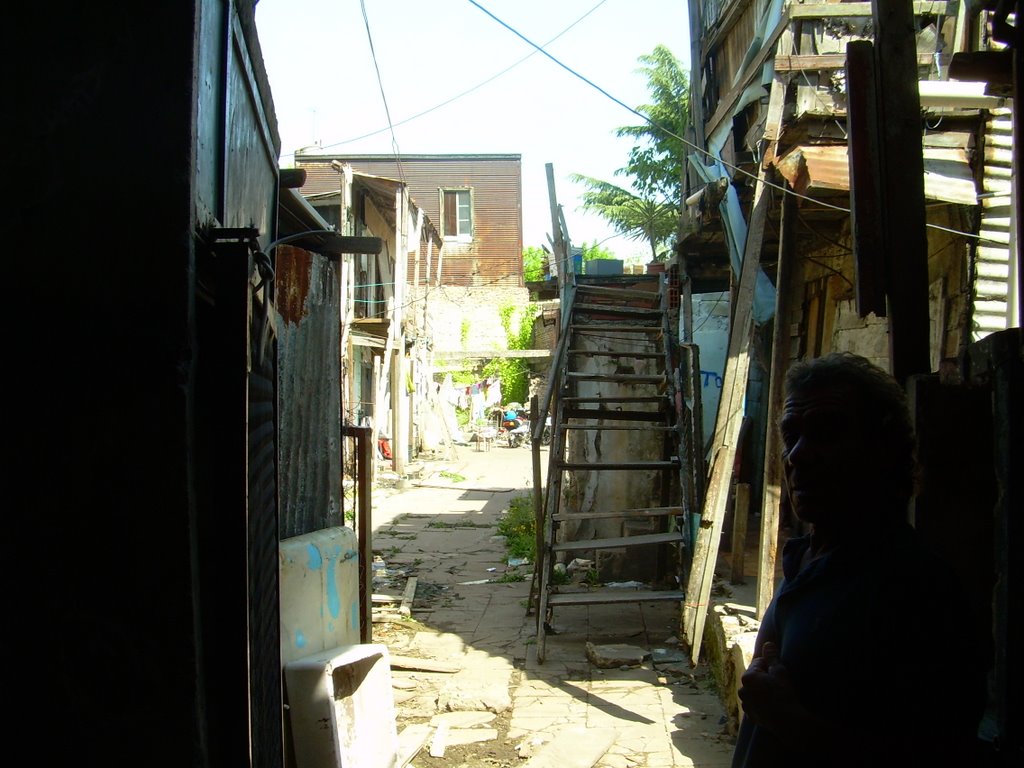
In the barrio of La Boca we can find a lot of tenements. These sites were the first homes of immigrants arrived early last century in Argentina. Currently still is, but they are places of transit, but became stable homes not only new immigrants but also people who live many years ago the Argentine territory. In turn, these sites are closely linked to tourism.
But what behind those bright colors and flashy
? Are they really safe places sanitary? Do they comply with the requirements for a home?
Everyone has the right to health, as individuals and it is the duty of the State brindárnosla.
also have the right to enjoy health conditions.
* A home must protect from inclement weather.
This is one of the first things to the tenements do not, because we can see and verify that these plates are constructed rather than vulnerable because they are bored easily because of thunderstorms and hail.
* A home must allow adequate rest of its inhabitants. In a tenement
whole families often live in a room of considerable size, but the meters are not only ensure that more than three people of different ages and sexes live together there.
* A home must preserve the privacy of their inhabitants.
Another issue that the tenement does not comply.
All families living in it, which can become more than ten, use the same bathroom, kitchen, "laundry" patio ...
* A home should be wide enough, comfortable and sanitary for their occupants to develop a physical and psychologically healthy.
All the above points We show that this is not fulfilled. What
expect the authorities to solve the housing problem not only in the neighborhood of La Boca, but also all those places that need it?
On the one hand we have seen tourists marveled replicas of the tenements, relating to the tango and the history of the neighborhood and a few blocks of "Caminito", we see the actual tenement with all the problems listed above.
So, we understand that all people who live there should not be doing in those conditions. If some have been renovated tenement can recover all those who are on the verge of collapse because of their age and lack of maintenance or not?
All this will take time and will also raise awareness to all the people there that this is not the best place to live healthy and properly. Will be convinced that their homes will be rebuilt and then may return. Of course I have to give them the assurance that this period of time will have a place in which to live. Is this possible?
When this problem is solved many people live a little happier, little by little your life will become different.
But what behind those bright colors and flashy
? Are they really safe places sanitary? Do they comply with the requirements for a home? Everyone has the right to health, as individuals and it is the duty of the State brindárnosla.
also have the right to enjoy health conditions.
* A home must protect from inclement weather.
This is one of the first things to the tenements do not, because we can see and verify that these plates are constructed rather than vulnerable because they are bored easily because of thunderstorms and hail.
* A home must allow adequate rest of its inhabitants. In a tenement
whole families often live in a room of considerable size, but the meters are not only ensure that more than three people of different ages and sexes live together there.
* A home must preserve the privacy of their inhabitants.
Another issue that the tenement does not comply.
All families living in it, which can become more than ten, use the same bathroom, kitchen, "laundry" patio ...
* A home should be wide enough, comfortable and sanitary for their occupants to develop a physical and psychologically healthy.
All the above points We show that this is not fulfilled. What
expect the authorities to solve the housing problem not only in the neighborhood of La Boca, but also all those places that need it?
On the one hand we have seen tourists marveled replicas of the tenements, relating to the tango and the history of the neighborhood and a few blocks of "Caminito", we see the actual tenement with all the problems listed above.
So, we understand that all people who live there should not be doing in those conditions. If some have been renovated tenement can recover all those who are on the verge of collapse because of their age and lack of maintenance or not?
All this will take time and will also raise awareness to all the people there that this is not the best place to live healthy and properly. Will be convinced that their homes will be rebuilt and then may return. Of course I have to give them the assurance that this period of time will have a place in which to live. Is this possible?
When this problem is solved many people live a little happier, little by little your life will become different.
Erica Vita
Tan Cover Pitted Scars
I knew something La Boca: he had two beautiful blocks they called "Caminito", where the Tango was out on the streets and showed others how they could dance a good guy on the sidewalk. In addition, there was located one of the country's largest fields, the so named "Bombonera" where thousands of people go through Sunday to encourage his love club: Boca Juniors.
That's what I knew.
But as often happens often ignored another very important part of the neighborhood.
When I visited, to explore it, I realized that several things did not.
seemed incredible, but there were two totally realities different in one place. With a difference of only three blocks could be seen as poverty continues to knock down a number while some others go to a beauty show with colorful walls and statues of Gardel and Evita.
I was sad to see such a sudden change. I was not expecting.
Two blocks from the prestigious "General Store", a strange business, "Fleas and Cockroaches" They sell antiques, used or old things. I went in, without thinking, I attended two people, a man and a woman, taking a few mates in a metal kettle mate dented and could use a cup. I asked a few things to start to warm up. One of them was where they had taken things. So it was that man stood up and started pointing me different objects explaining its origins. Almost everything we had was people falling apart from what was not useful. Some objects were inherited, but were put on sale, perhaps for lack of real feeling and many other things were sold for a great need for money.
was a jewelry box with a purple flower drawn "how cute this ... where he got it?" I asked grabbing. "It was my mom" heard a sad voice, "is reserved, I will buy a German who came yesterday." I did not ask more. I had enough.
Afterward, a somewhat rare finished getting to where they were these two people: a tenement that was falling apart, many dwelling-houses with curtains instead of doors and puddles at the entrance that looked pretty deep in my view.
not understand, how could it be that just two blocks from this place there were bars where your bars have details of silver, crystal glasses and wine to $ 145?
I thanked the man and went on my way. I walked a little more this slum, surrounded by Pizza, more tenements and fruit and vegetable markets. Beyond
me came across who were in a pizzeria in the same street as "Fleas and cockroaches." I went into a tiny place where he had photos of Maradona, Gardel and a telephone 1940. There was a deal much more vulgar, more friendly and a familiarity almost disrespectful. That place was good neighborhood, completely altered the landscape of Caminito.
I left there and I plunged even further. I went through the Bombonera, and around itself congenial to her. It was a blue and yellow world, where even insisted choripanes positions demonstrate their passion for the club Xeneize. Returning
seeing as I was going to transform business as it was approaching Caminito. Crossed these two blocks that are so famous in Argentina, watching closely. Painted a reality that was not consistent with the soul of La Boca. He was all dressed for anyone who wanted to tour completely sold. To outsiders. For tourists.
is how I took leave of the district. Now I had a totally different from above. I went to the stop 152 and waited while watching the stream that was by my side. I was a little lost, disappointed, dished. The group arrived and got out of inertia. The smell of Riachuelo was going a little and I left behind Caminito.
"Caminito friend, I'm going too ..."
Bethlehem Sabaté
Subscribe to:
Posts (Atom)