sheet:
Machuca - Chile- Spain-Britain-France, 2004, 120 minutes.
Director: Andrés Wood
Screenplay: Roberto Brodsky, Mamoun Hassan, Andrés Wood
Photo: Miguel Joan Littin
Music: José Miguel Miranda
Editor: Fernando Pardo
Starring: Matias Quer, Ariel Mateluna, Manuela Martelli, Aline Kuppenheim, Ernesto Malbran, Federico Luppi
Genre: Drama
A look innocent when the classes mix
Focusing on a young protagonist, the Chilean Andres Wood reflects the days before the coup that overthrew in September , 1973, Salvador Allende in Chile. The story is told from the eyes of a lower class boy, Pedro Machuca, who enters a school for rich kids, for a new project that had been made to ensure that all children have an equal education. During this project meets Gonzalo Pedro Infante comes from a family with a good financial move, but despite their differences to become friends.
What the director tries to show is like for two children the differences do not exist and can be great friends despite this. A truly moving story in every sense.
Machuca - Chile- Spain-Britain-France, 2004, 120 minutes.
Director: Andrés Wood
Screenplay: Roberto Brodsky, Mamoun Hassan, Andrés Wood
Photo: Miguel Joan Littin
Music: José Miguel Miranda
Editor: Fernando Pardo
Starring: Matias Quer, Ariel Mateluna, Manuela Martelli, Aline Kuppenheim, Ernesto Malbran, Federico Luppi
Genre: Drama
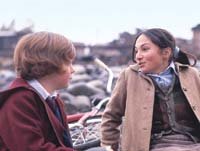
A look innocent when the classes mix
Focusing on a young protagonist, the Chilean Andres Wood reflects the days before the coup that overthrew in September , 1973, Salvador Allende in Chile. The story is told from the eyes of a lower class boy, Pedro Machuca, who enters a school for rich kids, for a new project that had been made to ensure that all children have an equal education. During this project meets Gonzalo Pedro Infante comes from a family with a good financial move, but despite their differences to become friends.
What the director tries to show is like for two children the differences do not exist and can be great friends despite this. A truly moving story in every sense.
Melina Soledad Menafra, Fiorella del Mazo
is an interesting film as it reflects a bit to Argentina because they are rich and poor is always the same struggle. This is noticeable
very large differences that exist and is also living in two very different realities.
The film talks about private school boys admitted lack of property by order of the school priest wanted to experience: to join the upper class to lower class.
As the film unfolds they become friends and Infante Machuca. Machuca is a poor boy and Infante the rich kid in the movie then you realize that a high-class child can never feel the same about a lower class because they live two different realities.
M elina Vega
The part that struck me most was when they killed the girl, who was lower class and was murdered for that reason, which shows a discrimination of these classes. A part that surprised me was the reaction of Machuca in the church to greet the father and the high class people also greeted him without showing differences noted after the event.
is a great film to reflect that everyone is equal in society as individuals and as part of it.
is a great film to reflect that everyone is equal in society as individuals and as part of it.
Karina Requena
director a private religious school, Father McEnroe, with support from parents, the school integrates children of alcoholics, several low-income families with the firm decision both groups learn to live together.
The father is a communist. It is approximately 50 years. When you start the coup in Chile, the military removed the priest and take over their school.
The film caused him more than a spectator emotion, she cried, laughed, as well as some not pleased, of course right?
The father is a communist. It is approximately 50 years. When you start the coup in Chile, the military removed the priest and take over their school.
The film caused him more than a spectator emotion, she cried, laughed, as well as some not pleased, of course right?
Daniela Argueyo
was Gonzalo who, for all lacked nothing, and Machuca was this guy who lived in a slum and had to work hard as her neighbor and friend and her family.
In Gonzalo's school (private, bilingual, Catholic) Father and director of it, scholarship to some kids in the village where he lived Machuca, to integrate different social sectors.
The problem with this is that the context was not the most appropriate and the country's situation went from bad to worse.
Socialists and Communists against the coup leaders usually upper middle class.
Gonzalo's family did not need anything as you need and more getting on the black market.
Gonzalo's father was a socialist, but the mother did not. In view of the world, a perfect marriage. In fact the mother's father cheated with someone older but wealthy; Meanwhile the father traveled a lot.
The hypocrisy and ignorance of the mother, from my point of view, not so much by deception married to the father, but by the situation that puts young son, who was an accomplice in his clandestine meetings with her lover giving gifts in return.
parallel, the initial situation at school was the logic, rich against poor, up to partial integration of the two classes.
Gonzalo Machuca and are joining more and more to the point where no longer interested in the external situation of the country, fall in love with the same girl and they share everything together.
But this friendship gradually feel the blows and the distancing own pressure from outside.
The military took power by social differences more obvious and painful, and going back on his father's footsteps. With coldness and cruelty
soldiers kill much of the lower class devastating all in the eyes of Gonzalo.
Her mother, who apparently just wanted every comfort possible to the hand that out, she marries the man of power and drag their children to that reality.
Samantha Suanni
This film contains a great social critic. It shows how the characters are crossed by the culture, social status. Them beyond their individuality, acting as a collective in critical moments of his life.
Gonzalo, overwhelmed by fear, responds as his mother when Machuca and his friend take the bike making a joke. The child reacts violently to the injustice of discrimination. All the characters are identified by their social class, and each has a symbolic significance: Machuca, means the topics about, because his presence causes us to wonder why the differences, Gonzalo is a summary of his class, but above all things, unlike her, is an icon of justice.
We can say that, beyond the story told, can be a social reading that indicates a problem: The injustice and class differences.
Elena Lodovico
What is good about this film is that it demonstrates very well the political aspects of those years focusing on everyday life and the beginning of the friendship of children who, by their difference in class would never have managed to be friends if it were not for the performance of a priest trying to integrate children of the villages in a school for the upper class. They develop very interesting scenes, one of the one I liked is when you fight the girl's mother Gonzalo or another, very emotional, when Machuca is the only fire the priest who is displaced by the military.
Alexis Losada


0 comments:
Post a Comment